
AI has quickly become a core part of how modern businesses operate. From simple automation to advanced data analysis, it’s helping companies move faster, uncover deeper insights, and spot opportunities that would otherwise go unnoticed.
But here’s the reality. While many companies are already using AI, not all of them are using it effectively. In many cases, the tools are in place, but the strategy behind them hasn’t caught up. The result is fragmented initiatives that look promising but fail to deliver meaningful business impact.
That’s where AI maturity comes in. It gives companies a clear lens to understand where they stand, whether AI is still in the experimentation phase or already driving real business outcomes at scale.
What Is an AI Maturity Model?
At its core, an AI maturity model is a framework used to evaluate how deeply AI is embedded within a company’s operations. It looks at critical factors like data readiness, technology platforms, team capabilities, and governance structures. By assessing these areas, companies can pinpoint their current stage in the AI maturity journey and identify what it takes to move forward and scale AI across the enterprise.
The 5 Stages of AI Maturity Companies Move Through
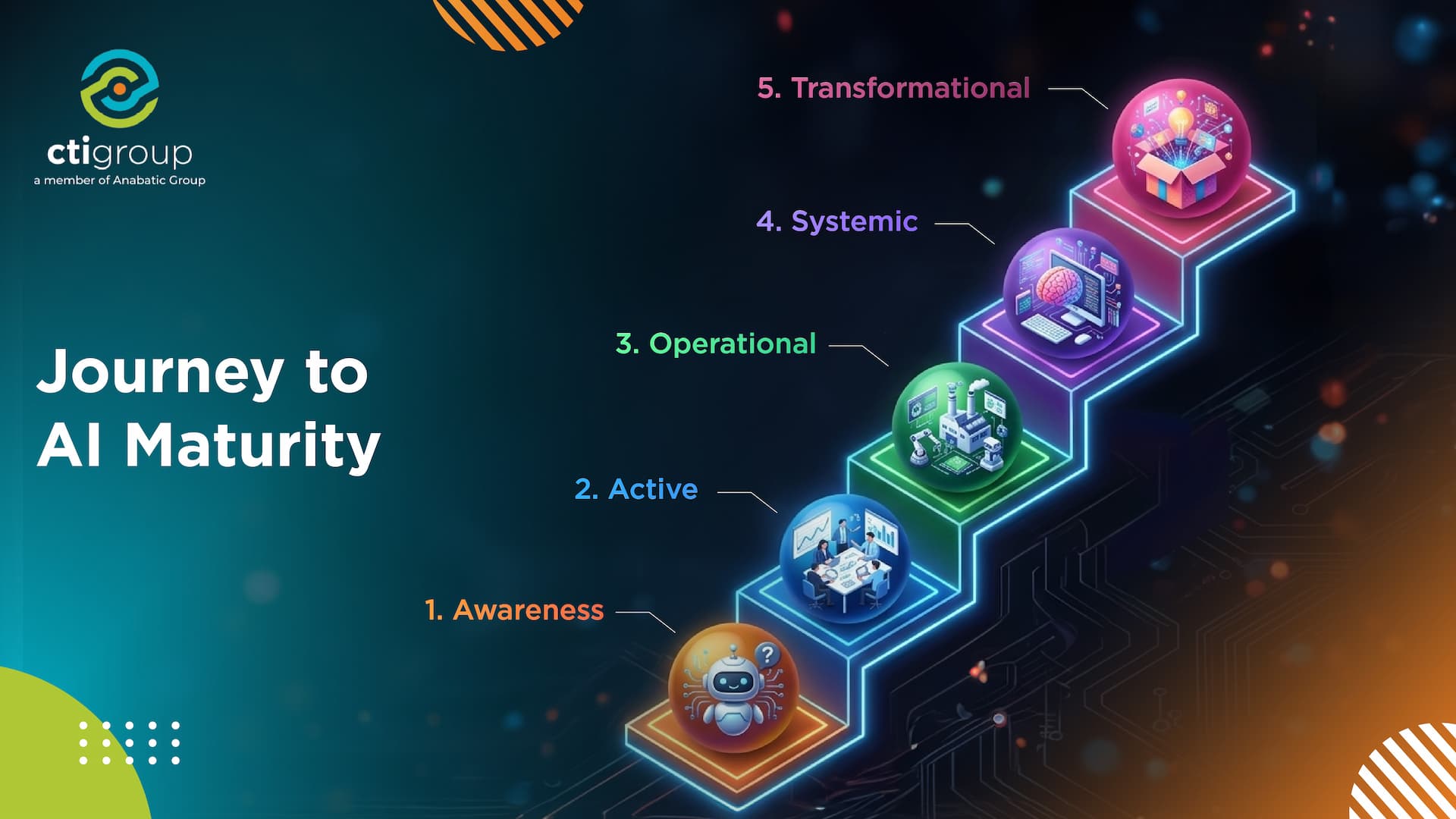
AI adoption doesn’t happen overnight. Most companies start small, experimenting with isolated use cases before gradually turning AI into a core business capability. The AI maturity model breaks this journey into five distinct stages, each representing a step toward more advanced and integrated AI adoption.
1. Building Awareness and Laying the Foundation
At this stage, companies are just beginning to explore what AI can do. The focus is on defining a vision, organizing data, and setting up initial structures like an AI Center of Excellence, a dedicated team that sets standards and guides how AI is developed and used across the company.
2. Running Pilots and Building Capabilities
With the basics in place, teams begin testing real-world use cases. Pilot projects like chatbots or predictive analytics tools are introduced to validate impact. At the same time, companies invest in upskilling to help teams start working more confidently with AI.
3. Operationalizing AI and Establishing Governance
Early experiments start delivering results, and AI begins to enter critical workflows. Governance becomes essential here. Companies introduce data management practices, system architecture standards, and frameworks like MLOps to ensure AI runs reliably and securely.
4. Scaling AI Across the Organization
AI is no longer isolated. It becomes part of everyday operations across departments. Teams use AI to improve efficiency, streamline processes, and unlock new opportunities. At this point, AI starts to function as a core business capability.
5. Transforming Business with Agentic AI
This is the most advanced stage of the AI maturity model. Companies begin leveraging agentic AI systems that can handle complex workflows, interact across multiple systems, and collaborate with humans in more autonomous ways. AI evolves into a true engine for business transformation.
Why the AI Maturity Model Matters for Enterprise Strategy
Without a clear framework, AI initiatives often end up scattered across teams. One group focuses on automation, another experiments with analytics, and nothing is fully connected. Understanding AI maturity helps bring everything together into a unified enterprise strategy. It shapes how companies invest in technology, manage data, and scale innovation.
Making Smarter Technology Decisions
When companies have a clear view of their AI maturity, decision-making becomes much more focused. Instead of guessing where to invest, leaders can prioritize what actually matters, whether that means strengthening data infrastructure, rolling out the right AI platforms, or building the talent needed to scale.
Building a Future-Ready Organization
A clear AI maturity roadmap allows companies to move faster when new technologies emerge. Instead of reacting, they can proactively use AI to drive efficiency and gain a competitive edge.
Stronger Data Governance and Risk Control
An AI maturity model pushes organizations to build stronger governance frameworks. This ensures AI systems are secure, transparent, and aligned with operational and regulatory requirements.
How to Assess AI Maturity Effectively
Assessing AI maturity requires a structured approach. Many enterprises conduct comprehensive AI readiness assessments to evaluate their capabilities end to end. The process typically includes a few key steps.
Evaluating Current Capabilities
Start with an internal audit. Through surveys and cross-functional discussions, companies can map their existing systems, data readiness, and talent capabilities to identify strengths and gaps.
Analyzing the Results
Once the data is collected, it needs to be analyzed to uncover bottlenecks and areas holding back progress. This step helps prioritize what needs to be addressed first.
Building a Roadmap Through Collaboration
Bring key stakeholders together to align on next steps. Use the assessment insights to build a clear AI roadmap that supports long-term business goals.
Read Also: AI Readiness Framework That Exposes Why Most Enterprises Fail
The Current State of AI Maturity in Indonesian Enterprises
AI maturity in Indonesia is progressing quickly, but unevenly across industries. While many enterprises are already using AI to improve efficiency and extract value from data, adoption levels still vary. Sectors like retail and wholesale are moving faster due to clearer business impact, with AI adoption in this space estimated to drive productivity gains of around 16 percent, or roughly Rp 230 trillion, according to research by Google and Public First.
At the same time, gaps in infrastructure, computing capacity, and skilled talent continue to shape how quickly organizations can scale AI. As these foundations improve and collaboration grows, more enterprises are expected to move from early adoption toward more mature, enterprise-wide AI implementation.
Read Also: AI Readiness: The Critical Foundation for Enterprise Innovation Success
Accelerating Enterprise AI Maturity with CTI Group
Advancing AI maturity requires more than just adopting new tools. It takes the right strategy, supported by strong data foundations, scalable infrastructure, and well-integrated systems.
CTI Group is a technology and digital solutions provider with over two decades of experience helping organizations design and build reliable IT infrastructure for digital transformation. Backed by a strong global partner ecosystem, CTI Group supports enterprises in strengthening their technology foundations and scaling AI initiatives in a more structured and sustainable way.
Learn how CTI Group can help accelerate your organization’s AI maturity and unlock the full potential of AI-driven transformation.
Author: Danurdhara Suluh Prasasta
CTI Group Content Writer
