
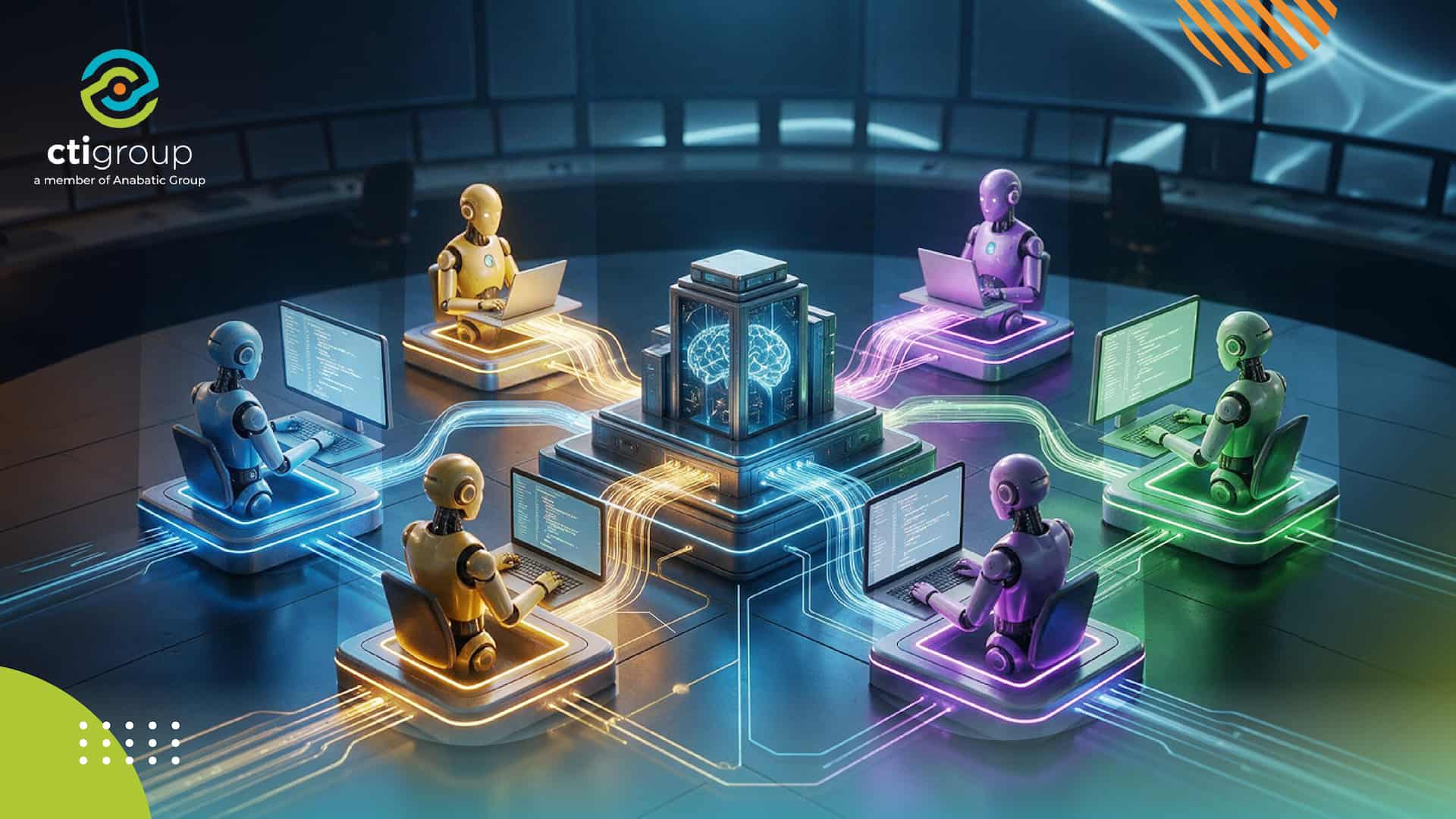
AI is no longer limited to answering questions or generating content. With AI agents, systems can understand goals, use tools, access data, and perform a series of actions with greater autonomy.
However, a single agent is not always the best approach for complex processes. When a workflow requires multiple areas of expertise, different data sources, or several decision-making steps, the work can be divided among specialized agents.
This is where Multi-Agent Systems (MAS) come in. Instead of relying on one agent to handle everything, a Multi-Agent System allows multiple agents with different roles to work together through defined coordination mechanisms. Each agent can focus on a specific task while the overall system manages how those tasks are executed and how their results are combined.
However, using multiple agents does not automatically make a system better. Additional complexity in areas such as latency, cost, security, and observability needs to be justified by clear business value.
What Is a Multi-Agent System?
A Multi-Agent System is a system consisting of multiple agents that can operate with relative autonomy, interact within an environment, and coordinate with one another to achieve a specific goal.
Google Cloud identifies three fundamental elements of a MAS: agents, environment, and interaction mechanisms. Agents make decisions and take actions; the environment is where they operate, and interaction mechanisms allow them to communicate and coordinate.
In modern LLM-based AI applications, an agent typically has a model, instructions, tools, and access to specific data or context. For example, a company could build a customer service MAS consisting of:
- Triage Agent to identify the type of customer request
- Knowledge Agent to retrieve relevant information
- Technical Agent to handle technical issues
- Billing Agent to check billing information
- Response Agent to generate the final response
With this approach, each agent can focus on a specific domain without necessarily having access to all the context and tools used by other agents.
Multi-Agent System vs. Single-Agent System: What’s the Difference?
A single-agent system uses one agent to understand a request, determine the required steps, use tools, and generate an output. This approach is sufficient for many use cases, such as internal chatbots, document summarization, knowledge retrieval, or workflows that use a limited number of tools.
A multi-agent system becomes more relevant when a single agent has too many responsibilities or when a workflow requires multiple areas of specialization.
Common indicators include:
- requiring expertise across multiple domains
- having different context requirements at different stages
- using many tools
- requiring multiple tasks to run in parallel
- requiring handoffs or delegation
- requiring different access levels at different stages
| Aspek | Single-Agent System | Multi-Agent System |
| Responsibility | Centralized in one agent | Distributed across agent |
| Context | Generally centralized | Can be separated by task |
| Workflow | Relatively simple | Can involve routing, hands-off, or parallel processing |
| Complexity | Lower | Higher |
| Best Suited for | Focused tasks | Complex, multi-domain workflows |
Therefore, MAS should be used when task specialization provides a clear advantage, rather than simply because the technology is available. It’s recommended to consider a single agent first when one agent with the right tools and context can already accomplish the task.
How Does a Multi-Agent System Work?
A typical MAS workflow can be represented as:
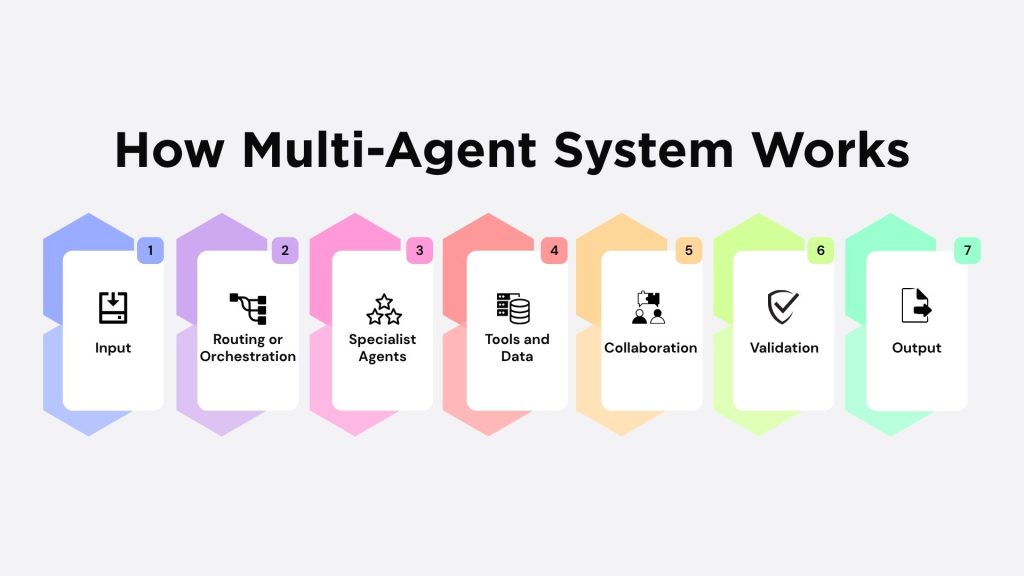
For example, suppose a company wants to compare three vendor proposals based on pricing, security, SLA, and compliance.
- The Orchestrator breaks the request into multiple tasks
- A Document Agent extracts information from the proposals
- Pricing, Security, and Compliance Agents perform their respective analyses
- If the tasks are independent, they can run in parallel
- An Evaluation Agent combines the findings and produces a recommendation
- If the decision carries significant risk, the result can be reviewed and approved by a human
Orchestration can be handled through code-based workflows or decisions made by an LLM. The OpenAI Agents SDK, for example, supports both approaches.
Core Components of a Multi-Agent System
Although the architecture of each MAS can differ, several components are commonly involved in modern AI-based implementations.
1. Agent
An agent is the unit responsible for reasoning and taking actions to complete a specific task. In LLM-based implementations, an agent can have instructions, a model, tools, guardrails, and capabilities for communicating with other agents.
Each agent should have a clear role and boundary. For example, a Billing Agent may only need access to billing systems and should not automatically have access to the company’s entire technical database.
2. Orchestrator
The Orchestrator manages which agents are executed, when they are executed, and how their results are passed between stages.
Orchestration can use:
- Router to select the appropriate agent
- Sequential workflow for dependent tasks
- Parallel workflow for independent tasks
- Manager to call specialist agents
- Handoff to transfer control to another agent
The OpenAI Agents SDK, for example, supports an agents-as-tools pattern where a manager retains control, as well as handoffs where a specialist takes over the task or conversation.
3. Memory and State
State represents the current condition of a workflow, while memory stores information that needs to be retained across interactions or processes. For example, a loan application workflow may maintain state indicating that the applicant’s identity has been verified, required documents have been received, and credit assessment is in progress.
For enterprise applications, memory should be designed around data retention, access control, and the types of information that can be stored. Not every agent needs to receive or retain all available information.
4. Communication Layer
The communication layer allows agents to exchange information through mechanisms such as APIs, shared state, events, or message queues.
The key consideration is not simply how agents communicate, but also data formats, authentication, authorization, error handling, and what information can be passed between agents.
Google Cloud identifies interaction mechanisms as one of the fundamental elements of MAS because agents need ways to communicate and coordinate with each other.
5. Tools and Environment
Tools allow agents to perform actions beyond the capabilities of the underlying model, such as accessing databases, CRM and ERP systems, enterprise search, APIs, or document repositories.
The environment is the space in which agents operate and interact with data, systems, or external conditions. In an enterprise environment, tool access should follow the principle of least privilege. An agent that only needs to read access should not automatically have permission to modify or delete data.
What Are the Business Benefits of Multi-Agent Systems?
Specialization
Agents can focus on specific domains, allowing their instructions, tools, and context to be more relevant to the task.
Complex Workflows
Large processes can be divided into smaller tasks that are easier to manage, such as vendor search → evaluation → security assessment → recommendation.
Parallel Processing
Independent tasks can run simultaneously, potentially reducing overall processing time.
Modularity
Individual agents can be developed or updated without redesigning the entire workflow.
Context Isolation
Each agent can receive only the context relevant to its task. This can improve focus while also supporting more controlled access to enterprise data.
However, these benefits do not automatically result from simply adding more agents. Workflow design, models, tools, and orchestration all influence the outcome.
What Are the Challenges of Implementing a Multi-Agent System?
Workflow complexity increases as the number of agents and execution paths grows. Systems need to handle timeouts, errors, retries, fallbacks, and cases where agents produce inconsistent results.
Latency and cost can also increase because each agent may generate additional model and tool calls. Organizations should therefore measure latency and cost at the workflow level, not just per model call.
Hallucination and error propagation are another concern because incorrect output from one agent can become input for another. Grounding, structured outputs, validation, and human review can help reduce these risks.
Security and access control must be applied to every agent and tool. At least privilege access becomes particularly important when agents can take direct actions in enterprise systems.
Finally, observability is becoming increasingly important. Teams need visibility into which agents were executed, which tools were called, the execution path, latency, errors, and model usage to identify problems effectively.
Real-World Applications of Multi-Agent Systems
MAS is particularly relevant to processes that require multiple areas of expertise, data sources, or decision-making.
Customer Service
A Triage Agent can identify a customer’s needs and route the request to a Billing, Technical Support, or FAQ Agent. This allows each specialist to focus on a specific domain.
Software Development
A workflow can be divided into requirement analysis → coding → testing → security review → documentation. Agents can assist at each stage, while developers retain review and approval before changes reach production.
Financial Services
MAS can support fraud investigation, risk assessment, document analysis, and compliance review. Because these use cases involve sensitive data and potentially high-impact decisions, they require access controls, audit trails, validation, and human oversight.
Supply Chain
Agents can support inventory monitoring, demand analysis, supplier evaluation, and procurement planning. For example, an Inventory Agent can identify a restocking requirement, a Supplier Agent can evaluate available vendors, and a Procurement Agent can prepare a recommendation.
Also Read: AI Agents in Supply Chain: Smarter Ways to Make Real-Time Logistics Decisions
Popular Frameworks for Building Multi-Agent Systems
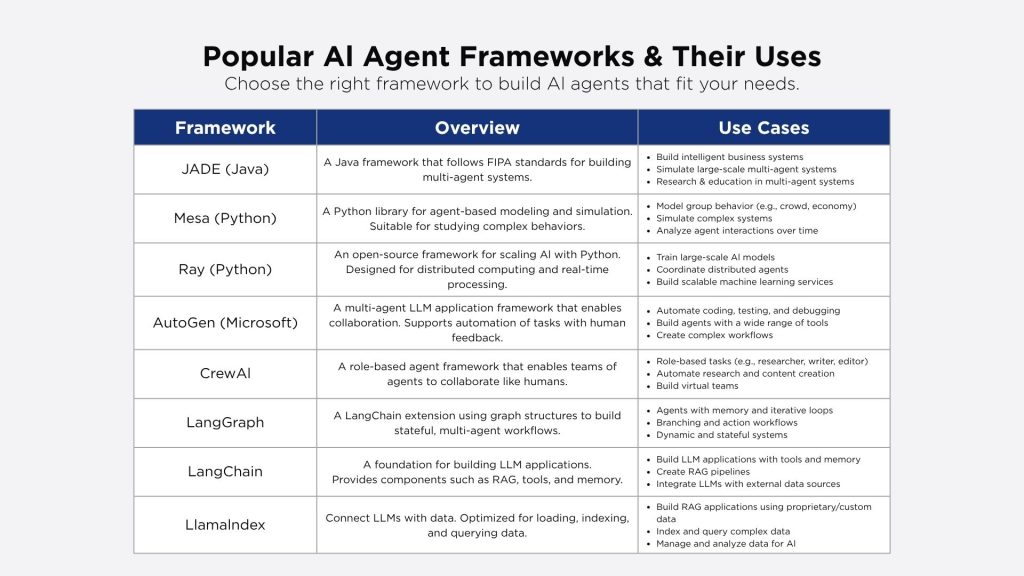 There is no single framework that is best for every organization. The right choice depends on workflow complexity, cloud ecosystem, team expertise, model providers, governance requirements, and production needs.
LangGraph
Advantages: Provides granular control over stateful and long-running workflows and is well suited for branching, looping, persistence, and human-in-the-loop processes.
Limitations: Requires stronger engineering expertise and can be unnecessarily complex for simple workflows.
Use cases: Complex agentic workflows with multiple states, conditional paths, or strict execution requirements.
Best suited for: Enterprises with strong engineering teams that need detailed control over orchestration and state management.
LangGraph is positioned as a low-level orchestration framework and runtime for building long-running, stateful agent workflows.
CrewAI
Advantages: Uses a role-based agent model that is relatively easy to understand. Crews support autonomous collaboration, while Flows provide more structured control over execution, state, and conditional logic. Limitations: Its higher-level abstraction can be less flexible for highly customized architectures.
Use cases: Research, content generation, business analysis, and workflow automation involving multiple specialist agents.
Best suited for: Teams that want to build multi-agent workflows quickly and combine autonomous agents with structured workflows.
Microsoft Agent Framework
Advantages: Provides agents, tools, memory/state management, telemetry, and graph-based workflows with routing, checkpointing, and human-in-the-loop capabilities.
Limitations: More complex than a lightweight agent for SDKs and particularly valuable when an organization already operates within the Microsoft ecosystem.
Use cases: Enterprise workflows requiring multi-agent orchestration, long-running processes, and integration with Microsoft/Azure environments.
Best suited for: Organizations with Microsoft/Azure technology stacks and structured enterprise workflow and governance requirements.
Microsoft Agent Framework is the successor to the approaches represented by AutoGen and Semantic Kernel. For new Microsoft-focused projects, it is therefore more relevant to evaluate the current framework rather than starting a new implementation with AutoGen.
Google Agent Development Kit (ADK)
Advantages: Provides capabilities for building agents, tools, orchestration, session/state management, and development workflows within the Google Cloud ecosystem. Google also provides tooling around evaluation, deployment, and observability. Google ADK Documentation
Limitations: Its ecosystem benefits are strongest for organizations already using Google Cloud. Enterprise deployments still require their own security, governance, and cost-control design.
Use cases: Enterprise AI and distributed agentic systems built within Google Cloud environments.
Best suited for: Organizations already using Google Cloud or planning to make it a core part of their AI infrastructure.
OpenAI Agents SDK
Advantages: Lightweight and provides straightforward primitives for agents, tools, handoffs, guardrails, and tracing. OpenAI Agents SDK
Limitations: Teams still need to design their own broader enterprise architecture, governance, integrations, and operational controls.
Use cases: Agentic applications requiring specialist agents, delegation, and handoffs.
Best suited for: Engineering teams that want to build agentic applications quickly and use the OpenAI ecosystem.
How to Implement a Multi-Agent System
Implementation should start with the business problem, not the framework.
1. Choose the right use case
Make sure the process genuinely requires multiple areas of expertise, different contexts, multiple tools, or coordinated workflows.
2. Map the workflow
Determine which steps require agents, and which can be handled by deterministic code or business rules. If a function can be reliably handled with code, it does not necessarily need to become an AI agent. Microsoft Agent Framework
3. Define agent roles and boundaries
Specify each agent’s responsibilities, tools, data access, expected outputs, and permissions.
4. Select an orchestration pattern
Use routing, sequential, parallel, manager, handoff, or combination depending on the workflow.
5. Apply security and governance
Implement least-privilege access, authentication, authorization, audit logging, data governance, and human approval for high-risk actions.
6. Build evaluation and observability
Measure accuracy, execution paths, latency, model usage, cost, tool success rates, and failure rates.
7. Start with a measurable pilot
Choose one workflow with clear business value and success metrics before expanding the number of agents and integrations.
Also Read: Why AI Pilot Often Fails? Check Out How Business Can Avoid It
Building the Right Multi-Agent System for Your Business
Multi-Agent Systems enable multiple specialized AI agents to work together on complex workflows. They can help organizations divide tasks, isolate context, run independent processes in parallel, and connect AI with enterprise tools and data.
However, MAS is not always the best choice. If a single agent or conventional workflow can already solve the problem effectively, adding more agents may only introduce unnecessary complexity and cost. For this reason, a successful MAS implementation should start with the business requirement, followed by the right design for agents, orchestration, data, security, and observability.
Looking to explore Multi-Agent Systems for your business? Discuss your business requirements and workflows with CTI Group to identify the right enterprise AI approach for your organization.
Author: Wilsa Azmalia Putri
Content Writer CTI Group
