
An AI agent stack is an architecture that enables AI agents to understand information, reason about goals, manage context, connect with external systems, and execute tasks autonomously. Unlike conventional chatbots that only respond to queries, AI agents can use tools and perform a series of actions.
Core Layers of AI Agent Stack Architecture
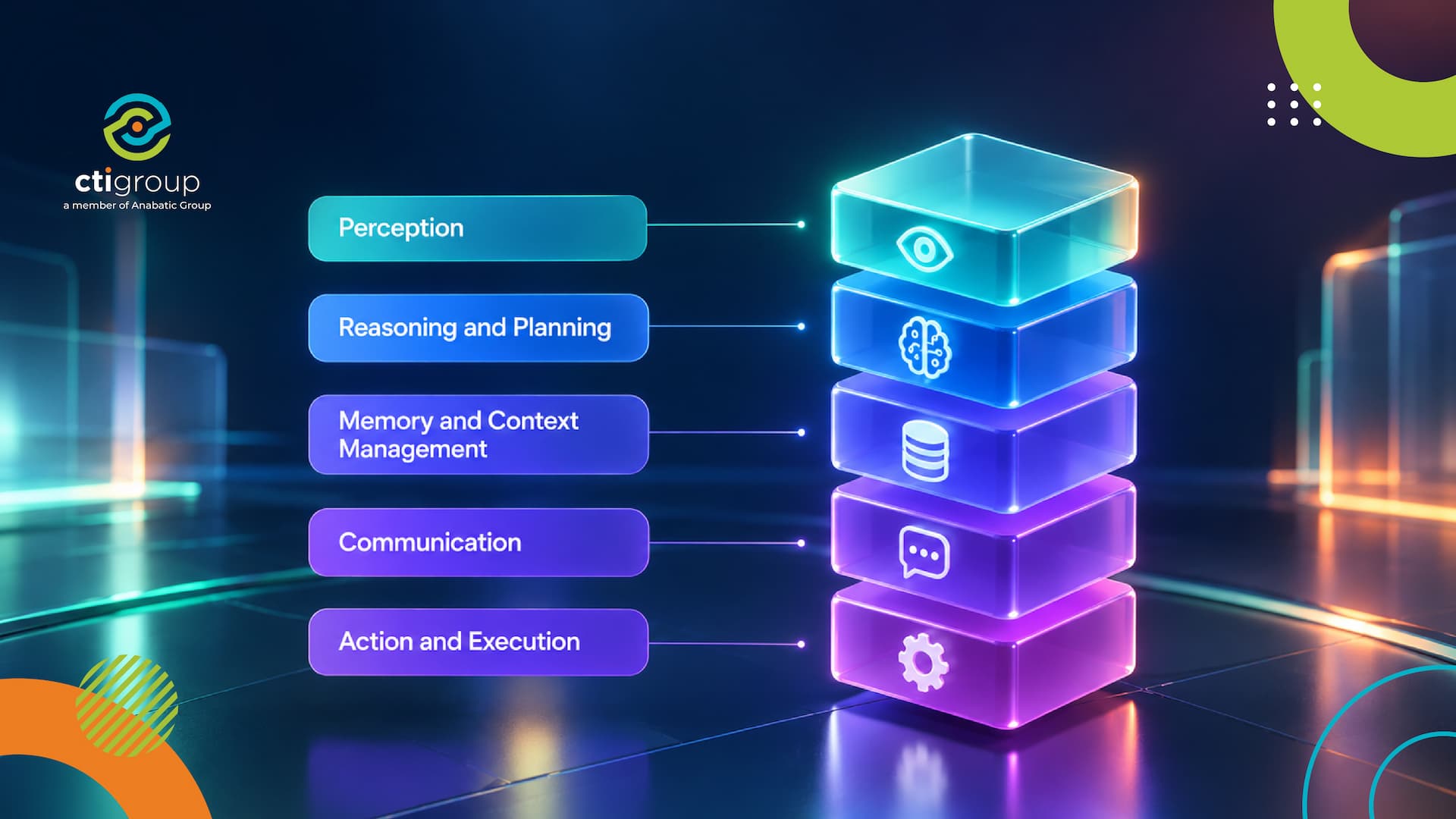
An AI agent stack can be organized into five conceptual layers: perception, reasoning and planning, memory and context management, communication, and action and execution. Actual implementations may combine several functions within a single framework or service.
Layer 1: Perception
Perception enables an AI agent to receive and interpret information from users, applications, or connected environments. Inputs may include text, documents, images, structured data, sensor readings, and API responses.
Layer 2: Reasoning and Planning
Using a large language model (LLM) and supporting logic to interpret objectives, this layer determines the next steps, selects tools, and evaluates results. Depending on the application, the agent may use step-by-step planning, tool calling, or predefined workflows.
Layer 3: Memory and Context Management
Memory allows an agent to retain information needed to maintain context and continue tasks. Short-term memory can store the current conversation or task state, while long-term memory can preserve relevant facts and preferences across sessions.
Retrieval-augmented generation (RAG) allows agents to retrieve information from external knowledge sources. Enterprise implementations should establish access controls, retention policies, and update mechanisms to prevent agents from relying on outdated or unauthorized information.
Layer 4: Communication
This layer connects agents with users, other agents, business applications, and external services. Integrations may use APIs, events, or protocols such as the Model Context Protocol (MCP), which enables compatible AI applications to discover and use tools exposed by external servers. In this layer, authentication, authorization, input validation, and least-privilege access should be enforced across integrations.
Layer 5: Action and Execution Layer
The action and execution layer carries out tasks based on the agent’s decisions. These actions may include creating support tickets, updating CRM records, processing service requests, or triggering automated workflows.
Every action should have appropriate permissions, operational limits, logging, and recovery mechanisms. High-impact operations, such as deleting data, approving transactions, or changing production configurations, should require human approval where appropriate.
Also Read: What are the Components of an AI Agent? Here are the 5 Core Elements
Popular AI Agent Frameworks and Tools
AI agent frameworks provide components for building, integrating, and orchestrating agents. The following technologies serve different purposes and are not all direct substitutes.
| Framework or tool | Primary purpose | Suitable applications |
| LangChain | Model, tool, and agent component integration | Agent prototypes and applications |
| LangGraph | Stateful workflow orchestration, persistence, and human-in-the-loop controls | Complex, multi-step processes |
| Microsoft Agent Framework | Agent development, workflows, and multi-agent orchestration | Enterprise applications using .NET, Python, or Go |
| AutoGen | Framework for single-agent and multi-agent applications | Agent collaboration experiments and workflows |
| Model Context Protocol (MCP) | Protocol for exposing tools and resources | Connecting agents to external systems |
Also Read: What Is a Multi-Agent System? Benefits, Architecture, and Real-World Applications
Emerging AI Agent Stack Trends in 2026
Based on McKinsey, several developments are shaping enterprise AI agent architecture in 2026:
- Multi-agent orchestration. Multiple specialized agents can collaborate on complex tasks. However, coordination introduces additional testing, oversight, and cost-management requirements.
- Interoperability through MCP. Standardized protocols help connect agents with tools and data sources without requiring every integration to be built from scratch. Authentication, permission controls, and server validation remain essential.
- Persistent memory and context management. Agents increasingly need mechanisms to preserve state, resume tasks, and retrieve relevant information across sessions. Memory architecture must account for privacy, data retention, and access permissions.
- Governance, observability, and human oversight. Enterprises need activity traces, outcome evaluations, cost monitoring, access controls, and approval mechanisms for high-risk actions. These capabilities are foundational to deploying agents in business-critical processes.
Also Read: How to Choose the Right AI Agent Strategy for Your Business?
Build Your AI Agent Strategy with CTI Group
Building effective AI agents requires more than selecting the right AI model. It also requires a well-designed technology stack that integrates data, applications, infrastructure, security, and governance to ensure AI agents deliver measurable business value.
Ready to turn AI agent opportunities into a practical business strategy? Contact the CTI Group team to explore the right technologies and solutions for your organization.
Author: Ervina Anggraini – Content Writer CTI Group
