
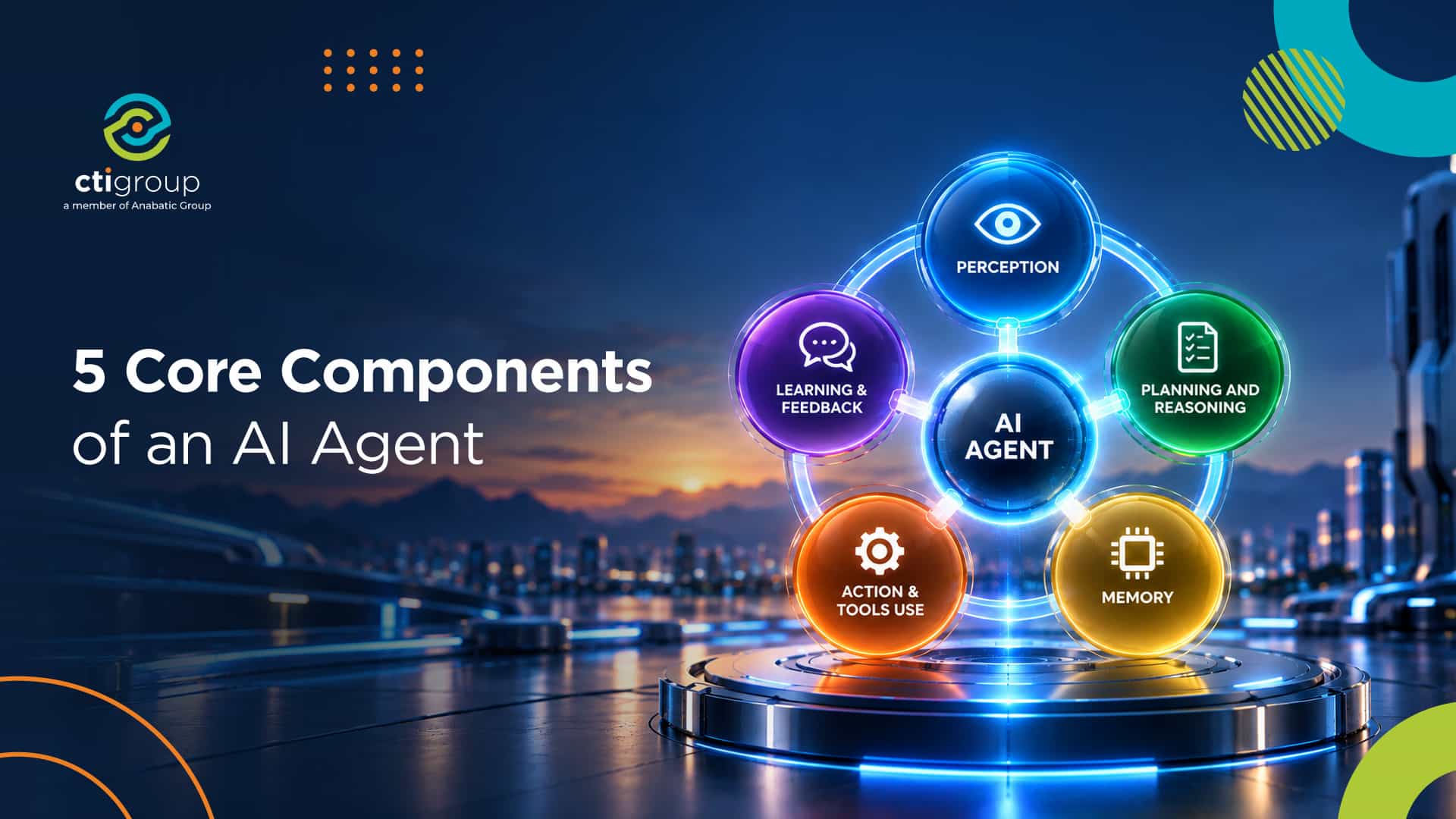
AI agents represent a major leap forward in artificial intelligence, empowering systems to execute complex tasks autonomously based on predefined goals. To achieve this, an AI agent must accurately interpret information, outline logical next steps, and interact dynamically with its environment or external systems. This power stems from a well-integrated ecosystem of fundamental components.
What are the exact AI agent components that drive this process? Let’s break them down.
Understanding AI Agents and How They Work
Before diving into the core architecture, it’s essential to understand what sets an AI agent apart from standard AI systems and how it processes a task from start to finish.
What is an AI Agent?
An AI agent is a software system designed to accomplish specific goals with a tailored level of autonomy. Unlike conventional systems that merely output fixed responses based on direct inputs, an AI agent can actively process data, map out necessary steps, leverage external tools, and continuously evaluate the outcomes of its actions.
However, an agent’s level of autonomy always depends on its predefined goals, business logic, data permissions, and guardrails. In other words, an AI agent isn’t an unchecked entity operating without human oversight. The initial architecture and safety boundaries dictate precisely what the agent is allowed to do and how far its decision-making authority extends.
How Does an AI Agent Work?
At its core, an AI agent operates through a continuous feedback loop. It perceives and interprets environmental cues, draws upon available knowledge and memory to analyze the situation, formulates an action plan, executes tasks, and uses the resulting feedback to refine its next move.
For example, a Customer Service AI Agent receives an inquiry, queries relevant information from an internal knowledge base, crafts an appropriate response, and delivers it to the user. If the issue requires additional intervention, the agent can autonomously trigger external tools, such as ticketing platforms or CRM systems, to drive the resolution forward.
Also Read: Many Businesses Still Get Them Wrong, Check the 6 Differences Between Agentic AI vs AI Agents
5 Essentials AI Agent Components You Need to Know
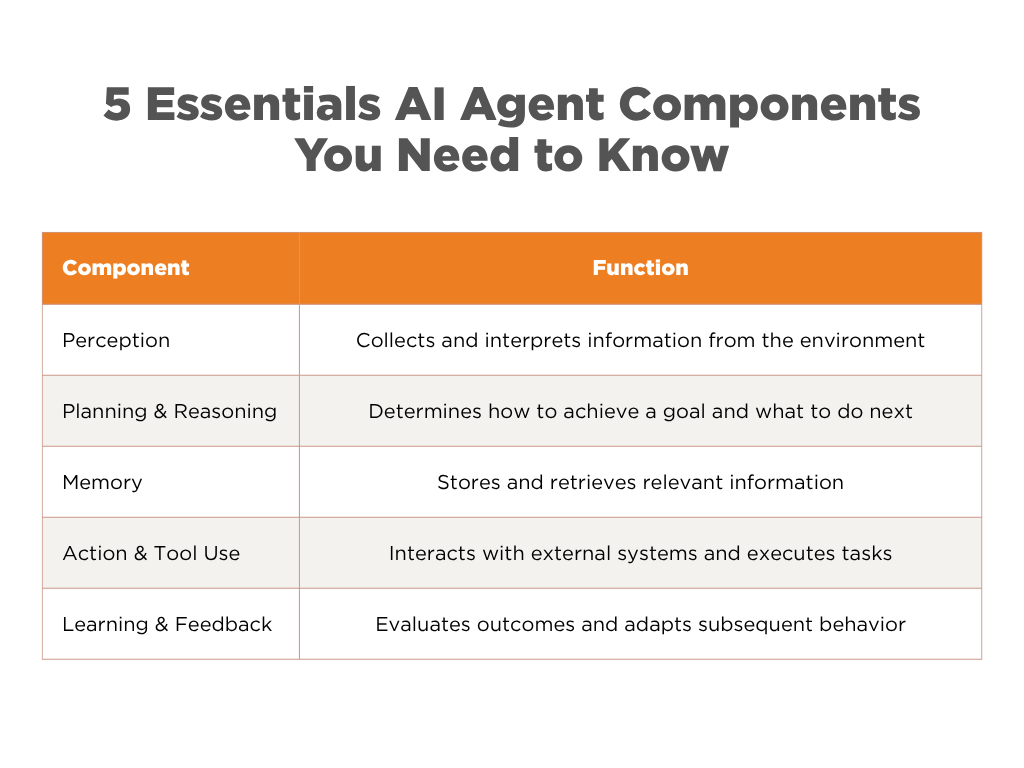 Together, these five components form an end-to-end operational pipeline that allows the agent to perceive conditions, make strategic decisions, and adapt based on results. While each element serves a distinct purpose, an agent’s true power lies in how seamlessly these components communicate within a unified architecture.
1. Perception
Perception is the entry point that allows an AI agent to sense, capture, and interpret inputs from its environment. These inputs can come in many forms: user prompts, database queries, API payloads, system logs, sensor signals, or unstructured documents. Raw data must first be structured and contextually understood before downstream components can use it.
In practice, perception relies on technologies like Natural Language Processing (NLP), speech-to-text, entity recognition, sentiment analysis, object detection, or structured data parsing. Getting this stage right is critical, any error in input comprehension will ripple down to distort subsequent decisions and actions.
2. Planning and Reasoning
Once the input is understood, the agent must figure out how to achieve its goal. The planning and reasoning engine enables the agent to break down complex tasks into manageable sub-steps, sequence actions logically, and weigh available context against changing variables.
For instance, when asked to resolve a complex customer complaint, the agent doesn’t just blurt out an instant answer. Instead, it methodically diagnoses the root issue, gathers supporting data, weighs potential solutions, checks if extra authorization or steps are needed, and selects the right tools to execute the fix.
3. Memory
Memory allows an AI agent to retain context and leverage valuable insights from prior interactions and past experiences. Generally, memory is divided into two operational layers: short-term memory, which holds active context during a live session, and long-term memory, which stores persistent knowledge for future reference.
In enterprise deployments, long-term memory is powered by knowledge bases, historical datasets, or vector embeddings. By remembering past context, the agent avoids starting every task from scratch and delivers far more personalized, context-aware outcomes.
4. Action and Tool Use
Action and tool use is where decisions transform into real-world execution. At this stage, the agent steps beyond conversation to invoke APIs, query databases, trigger automated workflows, interact with third-party software, or perform operations in digital or physical environments.
This ability to execute functional operations is what truly separates an AI agent from a standard conversational LLM. For example, an operations agent can read internal metrics, update CRM records, generate service tickets, or trigger supply chain workflows based on its reasoning.
However, access to tools must be strictly controlled. Implementing least-privilege permissions, robust authentication, input validation, and execution controls from day one ensures the agent’s actions remain safe and compliant.
5. Learning and Feedback
Learning and feedback create a continuous improvement loop, allowing the agent to refine its performance using results from past actions. Feedback can originate from system execution logs, performance metrics, updated datasets, or direct user responses.
This component is vital when operating in fast-moving, dynamic environments. Without effective learning mechanisms, an agent risks repeating the same mistakes over and over. That said, learning processes must be carefully governed so that behavioral adaptations remain audited and within designated operational guardrails.
How Do These 5 Components Work Together?
None of these elements operate in isolation. Perception captures data, Planning and Reasoning decides the path, Memory supplies vital context, Action and Tool Use execute the steps, and Learning and Feedback evaluate the outcome. The output of one stage instantly becomes the driving input for the next.
This iterative cycle enables the agent to operate dynamically. After completing an action, it captures new signals, updates its context, verifies whether the overarching goal has been met, and determines if further action is required.
Real-World Example: Customer Service AI Agent
Imagine an e-commerce company deploying an AI agent to handle order status requests. First, Perception receives the customer’s message and extracts key entities like the Order ID. The agent then references Memory to retain conversation history and uses Planning and Reasoning to determine that the order status must be queried from the Order Management System (OMS).
Next, Action and Tool Use trigger an API call to the OMS to fetch live tracking updates, allowing the retrieved data to be formatted into a natural response for the customer. Finally, if the customer provides feedback or further details, Learning and Feedback captures this interaction to evaluate performance and optimize future handling.
Also Read: AI Agents for HR: Optimizing Recruitment and HR Operations with Intelligent Automation
AI Agents in Supply Chain: Smarter Ways to Make Real-Time Logistics Decisions
AI Agents in Healthcare: Improving Operational Efficiency and Quality of Care
4 Critical Considerations Before Building an AI Agent
Building an enterprise-grade AI agent goes beyond pairing a language model with a few APIs. Each component must be engineered around specific goals, reliable datasets, required autonomy levels, and potential risk factors.
1. Clearly Define the Agent’s Scope
Start by establishing precise boundaries for what the agent should and shouldn’t do. The clearer the scope, the easier it becomes to define necessary data access, permissible tools, execution parameters, and edge cases where the agent must halt or escalate to a human.
For instance, a customer service agent can be authorized to answer FAQs and pull tracking info, but restricted from issuing refunds without explicit human approval.
2. Strictly Govern Data and Tool Access
Enforce the principle of least privilege. AI agents should only be granted access to the specific tools and data repositories required for their assigned roles. Strong authentication, strict input validation, and rate limiting help safeguard against unauthorized actions.
This governance is paramount when agents connect to enterprise environments containing sensitive customer data or core operational infrastructure.
3. Engineer for Resilience and Failure Recovery
Always design with the assumption that things can go wrong. Input misinterpretations, database downtime, API timeouts, invalid tool responses, or flawed reasoning can stall execution.
Build resilient workflows featuring robust error handling, automated retry logic, fallback mechanisms, and Human-in-the-Loop (HITL) checkpoints for high-stakes decisions. This ensures edge cases are handled safely without compounding risks.
4. Implement Comprehensive Monitoring and Observability
Continuous monitoring is essential to track whether your agent is achieving its goals safely and accurately. Key metrics to track include output accuracy, task completion rates, tool invocation success, system error rates, and user satisfaction scores.
Full observability, logging decisions, tool calls, and execution trails, gives engineering teams the visibility needed to debug failures, evaluate performance, and maintain audit readiness across enterprise deployments.
Also Read: How to Choose the Right AI Agent Strategy for Your Business?
Explore AI Agents for Your Business Together with CTI
AI agents empower organizations to automate complex workflows requiring contextual understanding, strategic decision-making, and direct execution. However, achieving optimal performance demands the right architecture, balancing perception, reasoning, and memory with robust governance over tools and data.
Ready to explore how AI agents can transform your business operations? Contact the CTI AI Experts team today to discuss tailored use cases and build a solution designed for your growth.
Author: Angela Merici Retna Perwitasari
Content Writer Intern CTI Group
