
Artificial Intelligence (AI) has evolved far beyond simple chatbots that answer questions. Today, AI systems can make decisions, execute tasks, and even coordinate complex workflows with minimal human intervention. As businesses continue exploring AI-driven automation, two terms often appear in discussions: AI agents and agentic AI. While they may sound similar, and are sometimes used interchangeably, they represent different concepts.
Understanding the difference between AI agents and agentic AI is essential for businesses looking to maximize the value of AI, whether for day-to-day operations, process automation, or long-term digital transformation initiatives.
What Are AI Agents?
AI agents are AI-powered systems designed to perform specific tasks automatically based on user-defined goals or instructions. Unlike traditional chatbots that simply respond to prompts, AI agents can take action by interacting with connected tools, applications, and data sources.
For example, an AI agent can schedule meetings, gather information from multiple sources, summarize documents, or send emails without requiring constant user input.
Key characteristics of AI agents include:
- Task-oriented and purpose-driven
- Able to use external tools and applications
- Operate based on predefined goals
- Require clear instructions, boundaries, and workflows
In simple terms, AI agents act as digital executors that help automate and streamline specific tasks.
What Is Agentic AI?
If AI agents focus on executing tasks, agentic AI operates at a higher level. Agentic AI refers to an AI approach that enables systems to reason, plan, make decisions, and determine the best course of action to achieve a goal with greater autonomy. Rather than simply carrying out instructions, agentic AI evaluates situations, breaks down problems into multiple steps, and chooses the most effective path forward.
Imagine asking AI to improve customer satisfaction. An AI agent might handle customer tickets or send feedback surveys. Agentic AI, however, can identify the root causes of customer complaints, develop an improvement strategy, prioritize actions, and coordinate multiple AI agents to execute the plan.
Key characteristics of agentic AI include:
- Advanced reasoning capabilities
- Autonomous planning and decision-making
- Ability to adapt to changing conditions
- Coordination of multiple processes and agents
- Focus on achieving broader and more complex goals
6 Key Differences Between Agentic AI and AI Agents
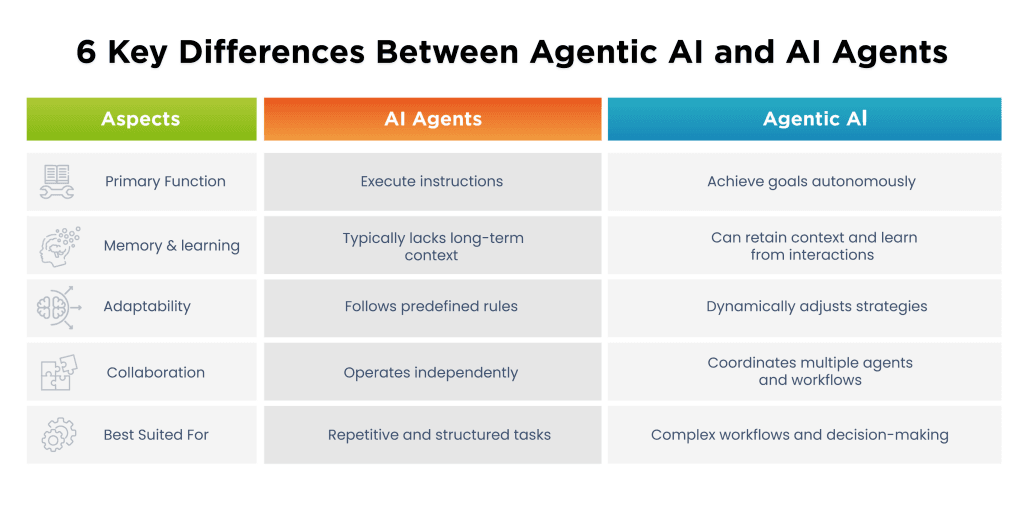 Simply put, AI agents are the task executors, while agentic AI serves as the decision-maker and orchestrator that determines how objectives can be achieved.
Check out the explanation here:
1. Primary Function
AI agents focus on executing instructions or tasks defined by the user. They operate based on predefined rules, workflows, or commands and are designed to complete specific actions efficiently. In contrast, agentic AI is goal oriented. Rather than simply following instructions, it can determine the necessary steps and actions required to achieve a desired outcome autonomously.
2. Autonomy
AI agents typically have limited autonomy because their actions are constrained by predefined parameters and instructions. Agentic AI demonstrates a higher level of autonomy, enabling it to make decisions, prioritize tasks, and select the most appropriate course of action to achieve a goal with minimal human intervention.
3. Memory & Learning
Most AI agents operate within the context of a specific task and may not retain information over the long term. Agentic AI, however, is designed to leverage memory and learning capabilities more effectively. It can maintain context across interactions, utilize previous experiences, and continuously improve its decision-making process based on new information and feedback.
4. Adaptability
AI Agents generally follow established rules and workflows, making them less flexible when conditions change. Agentic AI is more adaptable because it can dynamically adjust its strategies in response to new information, changing environments, or unexpected obstacles encountered during task execution.
5. Collaboration
AI Agents are often designed to work independently on specific tasks. Agentic AI can coordinate and collaborate with multiple agents or systems, distribute responsibilities, manage workflows, and combine outputs from different sources to achieve broader and more complex objectives.
6. Suitable Use Cases
AI agents are well-suited for repetitive, structured tasks with clearly defined processes, such as customer support automation, data processing, or workflow execution. Agentic AI is better suited for complex workflows that require continuous decision-making, planning, and adaptation, such as autonomous research, project management, business process optimization, and multi-agent orchestration.
AI Agents vs Agentic AI, Which One Is Right for Your Business?
AI agents are ideal when your business needs focus on automating clearly defined and repetitive tasks, such as responding to customer inquiries, generating meeting summaries, managing schedules and calendars, automating administrative workflows, and collecting data from multiple systems. In these scenarios, businesses primarily need operational efficiency without implementing highly complex AI systems.
Agentic AI becomes more relevant when objectives involve decision-making, planning, or coordinating multiple processes simultaneously, for example:
- Managing complex business operations
- Conducting risk analysis and generating recommendations
- Orchestrating multiple AI agents within a single workflow
- Supporting AI-driven decision-making systems
Because agentic AI operates with a higher degree of autonomy, it is typically best suited for use cases that require adaptability, strategic thinking, and continuous optimization.
How to Choose the Right AI Approach?
Before deciding between AI agents and agentic AI, consider these four following factors:
1. Your Primary Business Objective
If your goal is task automation, AI agents may be sufficient. If you’re aiming for intelligent decision-making and process optimization, agentic AI may provide greater value.
2. Process Complexity
The more variables, dependencies, and decisions involved, the stronger the case for adopting agentic AI.
3. Data and System Readiness
More autonomous AI solutions require mature data management, integrations, and governance frameworks to operate effectively.
4. Security, Transparency, and Oversight
Regardless of the approach, businesses should ensure proper controls are in place to maintain security, accountability, and compliance.
Frequently Asked Questions (FAQs)
1. Can AI Agents Operate Without Agentic AI?
Yes. AI agents can function independently to perform specific tasks without requiring agentic AI capabilities. However, their actions are typically limited to predefined workflows and instructions.
2. What Is the Main Difference Between Agentic AI and AI Agents?
The primary difference lies in autonomy and decision-making capabilities. AI agents focus on executing tasks, while agentic AI can reason, plan, and determine the best actions needed to achieve broader objectives.
3. How Do I Know Whether My Workflow Needs AI Agents or Agentic AI?
If your workflow follows clear, repeatable rules, AI agents are often the most practical choice. If it requires analysis, adaptation, and complex decision-making, agentic AI will likely deliver better results.
Read More: AI Readiness: The Critical Foundation for Enterprise Innovation Success
Accelerate Smarter AI Transformation with CTI Group
Understanding the difference between AI agents and agentic AI is only the first step. The real challenge lies in identifying the right approach to improve efficiency, support business growth, and deliver sustainable outcomes.
CTI Group helps businesses develop intelligent automation strategies tailored to their business goals, from identifying high-impact use cases and implementing AI solutions to continuously optimizing performance and maximizing business value.
Accelerate your AI transformation with CTI Group and unlock smarter, more measurable, and business-driven innovation.
Author: Angela Merici Retna Perwitasari
Content Writer CTI Group
