
For years, healthcare organizations have faced a growing challenge. While medical technology continues to advance and generate more clinical data than ever before, healthcare professionals are spending an increasing amount of time on administrative work—from documenting electronic health records and managing insurance claims to coordinating care across multiple departments.
As a result, valuable time that could be spent with patients is often consumed by repetitive operational tasks. This growing administrative burden has prompted many healthcare providers to look for ways to improve efficiency without compromising the quality of care.
One technology gaining significant momentum is AI agents. Unlike conventional AI systems that simply generate recommendations or respond to prompts, AI agents can execute a series of tasks autonomously to achieve a specific objective. For hospitals, clinics, laboratories, and other healthcare organizations, this opens new opportunities to streamline operations while keeping patient care at the center of every process.
Why AI Agents Are Becoming Essential in Healthcare
Several technology trends are driving the rapid adoption of AI agents across the healthcare industry.
Modern AI models have become significantly better at understanding natural language and clinical context. At the same time, healthcare organizations are generating increasing volumes of digital health data, while cloud infrastructure provides the scalability needed to process that information efficiently.
Together, these developments enable AI agents to support both clinical and operational workflows.
Rather than replacing healthcare professionals, AI agents are designed to reduce administrative workloads, allowing doctors, nurses, and medical staff to focus on responsibilities that require clinical expertise, critical thinking, and human judgment.
How AI Agents Are Being Used Across Healthcare
 Supporting Clinical Workflows
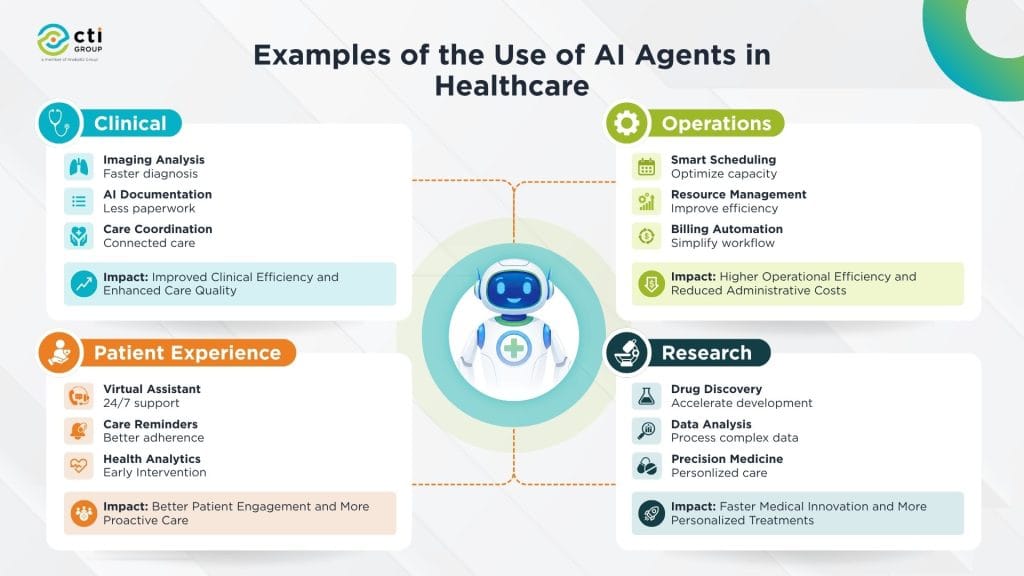
AI agents are increasingly helping clinicians reduce manual work throughout the patient care journey.
One common application is medical image analysis. AI can assist in reviewing MRI scans, CT scans, and X-rays by identifying areas that may require closer clinical attention, providing healthcare professionals with additional decision support before making a diagnosis.
Clinical documentation is another area experiencing rapid transformation. Using speech recognition and natural language processing, AI agents can generate draft clinical notes based on conversations between physicians and patients. Healthcare professionals remain responsible for reviewing and validating the documentation, but the administrative workload is significantly reduced.
AI agents can also coordinate patient care by managing referrals, scheduling follow-up appointments, and sending reminders throughout the treatment process.
Enhancing the Patient Experience
For patients, AI agents often serve as the first point of contact through virtual health assistants available around the clock.
These assistants can answer common questions, provide information about healthcare services, remind patients about upcoming appointments or medications, and simplify registration processes.
In some healthcare environments, AI agents also support population health initiatives by analyzing historical health records and clinical indicators to identify individuals who may require earlier intervention. These insights enable healthcare providers to take a more proactive approach to preventive care.
Optimizing Hospital Operations
Beyond patient-facing services, AI agents also improve operational efficiency across healthcare organizations.
Scheduling healthcare professionals, allocating hospital resources, and managing room availability can all be optimized using operational data and predicted service demand.
On the administrative side, AI helps automate medical coding, billing, and insurance claims processing. These capabilities reduce manual errors while improving revenue cycle efficiency and overall operational performance.
Accelerating Medical Research
AI agents are also transforming medical research by helping scientists process vast amounts of data more efficiently than traditional methods.
Researchers can leverage AI to identify promising drug candidates during early-stage discovery, analyze complex biological datasets, and support genomic research and precision medicine initiatives. While scientific validation remains essential, AI significantly accelerates the early phases of research, allowing organizations to shorten the path from discovery to innovation.
Also Read: Building Organizational Readiness for the Agentic AI Era
Benefits of AI Agents for Healthcare Organizations
The value of AI agents extends well beyond operational automation. From a clinical perspective, AI enables healthcare professionals to access relevant information more quickly, supporting faster and better-informed decision-making. By reducing repetitive administrative work, physicians and care teams can dedicate more time to patient interaction and care delivery.
Operationally, workflow automation improves resource utilization, accelerates administrative processes, and helps organizations manage costs more effectively. As healthcare providers continue to face rising patient volumes and increasing operational complexity, these efficiencies play an important role in maintaining high-quality healthcare services.
The Future of AI Agents in Healthcare

AI agents are still in the early stages of adoption, but their potential continues to expand.
In the coming years, healthcare organizations are expected to adopt collaborative multi-agent systems capable of supporting end-to-end care processes across departments and clinical environments.
Advances in precision medicine, genomics, and healthcare data interoperability will further strengthen the role of AI agents in delivering more personalized, data-driven care.
Over time, these technologies may also help shift healthcare from a reactive model, focused on treating illness after it occurs, to a more preventive approach, where AI continuously analyzes data to identify health risks before they become serious medical conditions.
Also Read: The Rise of Agentic AI Indonesia: What 2026 Will Demand from Leaders?
Build Your AI Strategy for Healthcare with CTI Group
Successfully implementing AI agents requires more than deploying new technology. Healthcare organizations also need a well-defined strategy, a secure and scalable infrastructure, and an implementation approach that addresses data security, regulatory compliance, and integration with existing healthcare systems.
CTI Group helps healthcare organizations develop AI adoption roadmaps tailored to their operational and business objectives. From identifying high-value use cases and designing AI architectures to deploying enterprise AI solutions, our team supports every stage of the transformation journey.
Interested in exploring how AI agents can improve operational efficiency while enhancing the quality of healthcare services? Connect with CTI Group to discuss the right AI implementation strategy for your organization.
Author: Wilsa Azmalia Putri – Content Writer CTI Group
