
Organizations across industries are racing to adopt AI. Companies are investing heavily in infrastructure, hiring AI talent, purchasing the latest tools, and launching pilot projects that promise transformative results. Yet behind the excitement, a growing reality is becoming harder to ignore: many AI initiatives never deliver meaningful business impact.
Research continues to show that a large number of AI pilots fail to evolve into scalable, production-ready implementations. The issue is rarely a lack of ambition or technology. More often, the real challenges emerge when AI moves beyond controlled testing environments and into day-to-day business operations.
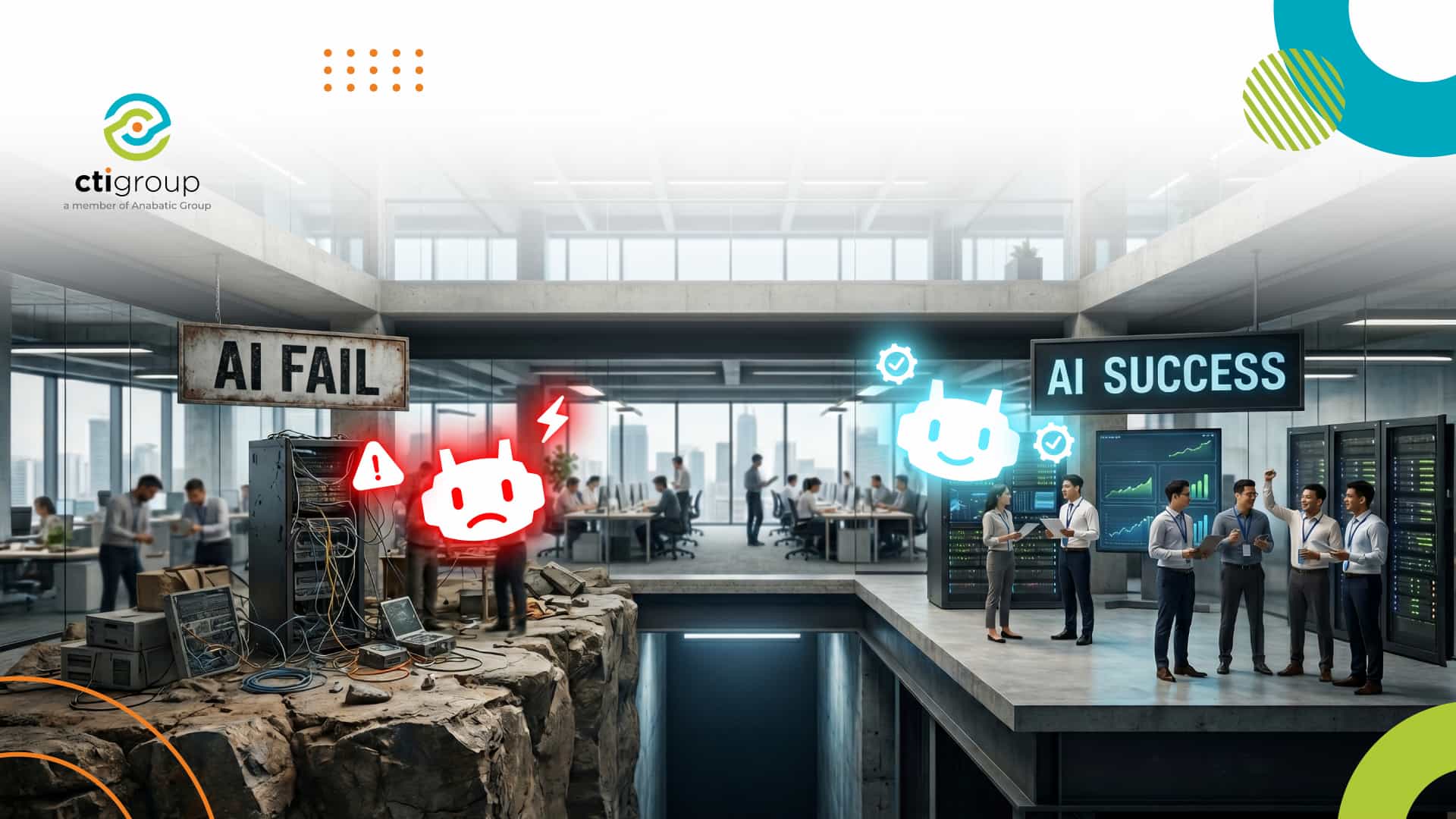
This is where the AI execution gap begins to surface; the disconnect between being technically prepared for AI and being operationally capable of deploying it effectively at scale.
Unless organizations address this gap seriously, AI investments risk becoming impressive demonstrations of technology rather than long-term drivers of business value.
AI Readiness Does Not Automatically Create Business Value
Many organizations still define AI readiness as simply being prepared to purchase and implement AI technologies. AI readiness is far broader than adopting new tools or platforms.
True AI readiness involves organizational preparedness across multiple layers, including workplace culture, business processes, data governance, technology infrastructure, and workforce capabilities. A company may have modern infrastructure in place but still struggle with AI adoption if its processes are fragmented, its data governance is inconsistent, or its culture resists operational change.
This has become increasingly important as AI, particularly generative AI, expands rapidly across industries. Staying competitive today requires more than understanding how to use AI tools. Organizations also need to understand how AI can create measurable operational and business impacts.
In other words, AI readiness is only the foundation. Without a clear execution strategy, that foundation alone is not enough to drive sustainable transformation.
Also Read: AI Readiness: The Critical Foundation for Enterprise Innovation Success
Why Many AI Implementations Stall Before Delivering Results
In many cases, failed AI initiatives are not caused by weaknesses in the AI model itself. The bigger issue often lies within the organization’s operational environment.
Data remains scattered across disconnected systems; infrastructure is not designed for real-time processing, and many business workflows still rely heavily on manual processes that are difficult to automate.
As a result, AI systems struggle to generate consistent, reliable insights. Even when the models perform well technically, organizations often face difficulties turning AI-driven insights into operational actions that improve business performance.
This creates a common misconception where companies believe they are already “AI-ready,” while AI is only operating at the surface level without the operational maturity needed to support it effectively.
4 Common Areas Behind the AI Execution Gap
 Before accelerating AI adoption, organizations first need to identify where the execution gap actually exists. Without proper evaluation, AI investments can easily remain stuck as isolated experimentation projects with limited business impact.
1. Aligning AI Initiatives with Business KPIs
One of the most common reasons AI projects fail to scale is because they are not directly tied to core business objectives.
Many organizations pursue AI initiatives because of innovation pressure or market trends but lack clear success metrics from the beginning. As a result, AI programs may appear active internally while struggling to demonstrate a measurable impact on revenue, operational efficiency, customer experience, or productivity.
Every AI use case should be connected to measurable business KPIs. For example, if AI is implemented in customer service operations, success should be evaluated through metrics such as faster response times, improved customer satisfaction, or lower operational costs.
Without clear alignment to business outcomes, even highly accurate AI models may fail to gain support from stakeholders.
2. Evaluating Data and Production Infrastructure Readiness
Many AI models perform exceptionally well during demos or proof-of-concept stages but begin to struggle once deployed into real production environments.
This typically happens because enterprise data is inconsistent, fragmented across platforms, or unavailable in real time. At the same time, legacy infrastructure often lacks the scalability and responsiveness required to support modern AI workloads.
To evaluate production readiness, organizations should address several key questions:
- Is the data consistent enough to support real-time inference?
- Can the infrastructure handle latency and growing data volumes?
- Are monitoring systems in place to detect model degradation before it affects business performance?
Visibility into model performance, system reliability, operational costs, and AI latency is equally important, yet often overlooked during early experimentation phases.
3. Identifying Governance and Ownership Gaps
AI implementation is not solely the responsibility of IT or data science teams. Successful AI adoption requires collaboration across leadership, operations, legal, security, and compliance functions.
However, many organizations still lack clear ownership structures for AI initiatives. Governance frameworks are often underdeveloped, resulting in slower decision-making and increased operational risk.
Interestingly, a global DXC study found that 73% of leaders still believe AI initiatives should primarily be led by technical teams. Business teams play an equally critical role because they understand operational workflows, customer expectations, and regulatory requirements better than anyone else.
Organizations, therefore, need clear governance structures that define ownership across AI development, data quality, security, compliance, and ongoing model evaluation.
4. Reviewing AI Scalability and Lifecycle Management
The challenge does not end once an AI model is deployed. Organizations must also ensure AI systems remain accurate, relevant, and adaptable as business conditions and data evolve over time.
Many companies still lack a mature AI lifecycle management strategy. Models that initially perform well can quickly degrade due to shifting data patterns, changing business requirements, or insufficient monitoring practices.
This is why organizations need continuous visibility into model performance, operational costs, latency, and system reliability. A sustainable lifecycle management approach helps ensure AI continues delivering business value well beyond the initial deployment phase.
Also Read: AI Readiness Framework That Exposes Why Most Enterprises Fail
3 Practical Strategies for Closing the AI Execution Gap
 Understanding the execution gap is only the beginning. The next challenge is closing that gap so AI can generate measurable business outcomes.
1. Treat AI Execution as a Shared Business Responsibility
Many organizations already recognize AI as a board-level strategic priority. However, implementation efforts often stall because execution is still viewed primarily as a technology initiative.
DXC research highlight this disconnects clearly: while 77% of organizations consider AI a board-level priority, 94% still face major implementation challenges. The problem is no longer awareness; it is execution.
AI creates the greatest value when embedded directly into core business functions such as operations, compliance, customer experience, and R&D. That is why business leaders across departments need to be actively involved in defining AI priorities and ensuring implementation aligns with business objectives.
2. Integrate AI with People and Business Processes
AI transformation efforts rarely succeed when organizations focus only on the technology itself.
AI needs to be integrated into how people work, how decisions are made, and how operational workflows function on a daily basis. In many cases, the most effective approach is not full automation, but collaborative AI models where humans remain involved in critical decision-making.
This aligns with DXC survey findings, where 54% of business leaders expect AI to operate in a partially autonomous model, supporting decisions while humans maintain oversight over critical actions. Organizations therefore need to rethink workflows, governance structures, and workforce development strategies to support effective AI adoption.
Equally important, 81% of executives expect workforce upskilling, and talent development needs to increase significantly over the coming years. Investment in people will remain a key part of successful AI transformation.
3. Build the Right Strategic Partnerships
Closing the AI execution gap is difficult to achieve alone. Many organizations require partners that understand the complexity of enterprise-scale AI implementation.
According to DXC research, 75% of business leaders are actively pursuing external partnerships to support AI initiatives, ranging from AI solution providers to data and analytics partners.
The right partnership is not only about technology procurement. It is also about having a strategic partner capable of supporting organizations across planning, integration, governance, and production deployment.
This approach has already shown measurable results, with 79% of CIOs reporting that partnerships with service providers helped improve customer experience and accelerate digital transformation efforts.
Also Read: Building Organizational Readiness for the Agentic AI Era
Accelerate Your AI Transformation Journey with CTI Group
AI readiness is an important starting point. But without a strong execution strategy, readiness alone will never translate into real business outcomes. Closing the AI execution gap requires organizations to align technology, data, business processes, governance, and workforce capabilities into a unified implementation strategy.
With the right end-to-end approach, organizations can move beyond isolated pilot projects and build scalable, reliable AI solutions that deliver measurable business impact in real production environments.
Take the next step in accelerating your AI readiness and execution strategy with end-to-end solutions from CTI Group and build AI transformation initiatives that are scalable, reliable, and production-ready.
Author: Wilsa Azmalia Putri – Content Writer CTI Group
