
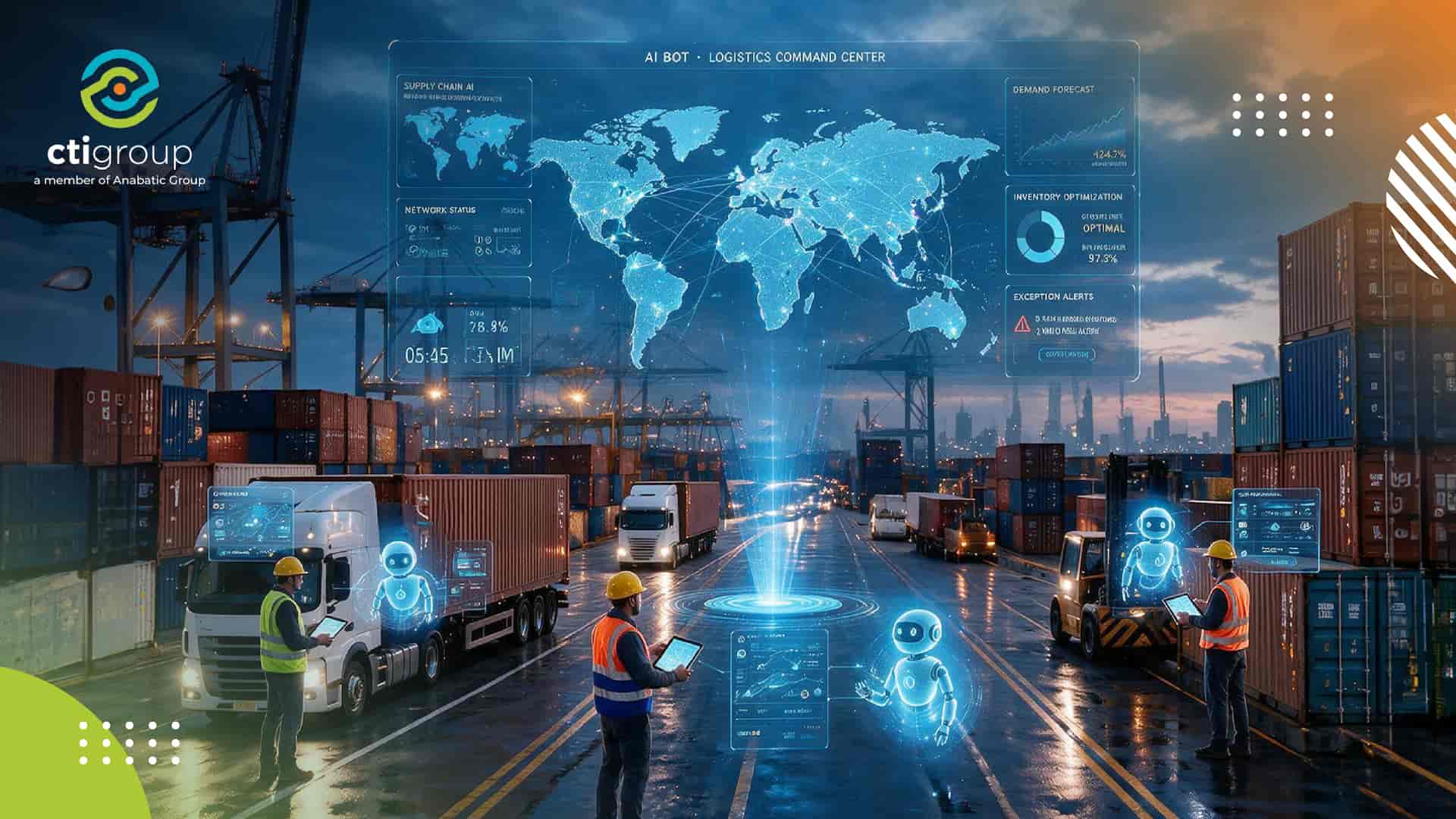
Imagine a manufacturing company coordinating hundreds of suppliers across multiple countries, managing warehouses in dozens of locations, ensuring on-time deliveries to thousands of distribution points, while keeping inventory levels balanced to avoid both shortages and excess stock. Every one of these activities must run simultaneously, day after day.
For years, companies have relied on a combination of spreadsheets, manual planning, and ERP systems that still require human intervention at nearly every decision point. While these tools have supported day-to-day operations, they often struggle to respond quickly when unexpected disruptions occur, whether caused by global supply chain issues, sudden spikes in demand, or severe weather affecting transportation routes.
As supply chains become more dynamic and interconnected, businesses need a more adaptive approach to decision-making. This is where AI agents are making a difference. Rather than simply analyzing data, AI agents can evaluate changing conditions, make informed decisions, and take autonomous actions, enabling supply chains to respond to disruptions faster and operate with greater agility.
What Are AI Agents in Supply Chain?
AI agents in the supply chain are intelligent software systems designed to monitor operations, analyze data, make decisions, and execute actions autonomously based on predefined business objectives.
Unlike traditional rule-based automation, which follows fixed instructions, AI agents continuously assess changing conditions, evaluate multiple courses of action, and determine the most appropriate response based on real-time context.
To achieve this, AI agents combine data from multiple sources, including ERP systems, IoT sensors, warehouse management systems (WMS), transportation platforms, and external information such as weather conditions, traffic updates, and market trends. Instead of simply generating reports for human review, they transform this information into actionable decisions that can be applied directly to supply chain operations.
How Do AI Agents Work?
In complex supply chain environments, AI agents continuously process information and make decisions through a cycle of observation, reasoning, and action. This enables them to respond quickly to changing conditions while keeping operations running efficiently.
Observe
AI agents continuously monitor real-time data across the supply chain, including inventory levels, shipment status, supplier performance, demand fluctuations, and external factors that could impact operations.
Reason
The collected data is then analyzed using machine learning models and AI reasoning capabilities to evaluate multiple scenarios, assess potential risks, and determine the most effective course of action based on business objectives.
Act
Once a decision is made, AI agents can either provide recommendations or execute predefined actions automatically. These actions may include adjusting production schedules, rerouting shipments, reallocating inventory, or selecting alternative suppliers when disruptions occur.
What sets out AI agents apart from traditional AI solutions is their ability to collaborate. Multiple agents can share information and context in real time, allowing decisions made in one function, such as logistics to immediately influence production planning, inventory management, or procurement. Instead of operating in silos, different parts of the supply chain work together as a connected ecosystem.
Also Read: AI Agents for HR: Optimizing Recruitment and HR Operations with Intelligent Automation
Benefits of AI Agents in Supply Chain
 By continuously analyzing data and responding to operational changes in real time, AI agents deliver measurable improvements across the supply chain. Beyond increasing efficiency, they also help organizations become more resilient, scalable, and responsive in an increasingly unpredictable business environment.
Faster Decision-Making
AI agents continuously analyze operational data, enabling organizations to respond to disruptions in minutes instead of hours or days. According to the IBM Institute for Business Value, 62% of supply chain leaders believe embedded AI agents can significantly accelerate decision-making across operational workflows.
Greater Operational Efficiency
By optimizing inventory, production schedules, and logistics, AI agents help reduce storage costs, minimize stock shortages and overstock situations, and improve overall supply chain performance.
A More Resilient Supply Chain
AI agents can identify potential disruptions before they escalate into larger operational issues. This enables businesses to take proactive measures, reduce risks, and maintain business continuity even during unexpected events.
Improved Business Scalability
Once proven effective, AI-driven decision models can be applied across additional warehouses, product lines, or regions without requiring a proportional increase in operational resources.
Higher Team Productivity
By automating repetitive monitoring and analytical tasks, AI agents allow supply chain teams to focus on higher-value activities such as strategic planning, supplier collaboration, and complex decision-making.
Real-World Use Cases of AI Agents in Supply Chain
 The benefits of AI agents are no longer theoretical. Today, organizations are deploying them across multiple stages of the supply chain to improve decision-making, increase operational efficiency, and proactively manage risks. Here are some of the most common use cases.
Demand Forecasting
AI agents continuously refine demand forecasts by analyzing historical sales data, market trends, promotional activities, and other real-time signals. This allows businesses to adjust inventory levels and production plans more accurately while reducing the risk of overstocking or stock shortages.
Smarter Procurement
By monitoring supplier performance, raw material prices, and potential geopolitical risks, AI agents can identify the best sourcing options or recommend alternative suppliers before disruptions impact operations.
Adaptive Production Scheduling
When unexpected events such as order changes, material shortages, or equipment failures occur, AI agents can automatically recalculate production schedules and recommend the most efficient adjustments to minimize downtime.
Warehouse Management
AI agents help optimize warehouse operations by dynamically managing inventory placement, product movement, and order picking based on real-time operational conditions. This improves warehouse efficiency while accelerating order fulfillment.
Logistics Optimization
Using real-time traffic data, weather conditions, and shipment status, AI agents can recommend or automatically adjust delivery routes to improve transportation efficiency and help ensure on-time deliveries.
Proactive Risk Monitoring
AI agents continuously monitor both internal and external risk indicators, from supplier performance and operational data to market events and infrastructure disruptions. This enables organizations to identify potential issues earlier and take preventive action before they escalate.
The Future of AI Agents in Supply Chain and Logistics
As more organizations begin to realize the value of AI-driven decision-making, the role of AI agents is expected to extend far beyond automating individual tasks.
In the years ahead, multiple AI agents will collaborate across an integrated ecosystem spanning procurement, manufacturing, warehousing, logistics, and distribution. By continuously sharing data and operational context, these agents will enable supply chains to function as adaptive, connected systems rather than isolated business processes.
This evolution will pave the way for smarter warehouses, more proactive logistics operations, and AI-assisted decision-making across virtually every stage of the supply chain. Gartner predicts that by 2028, approximately one-third of enterprise software applications will incorporate AI agent capabilities, a significant increase from just a few years ago.
For organizations in Indonesia, this presents an opportunity to build supply chains that are more efficient, resilient, and better prepared for an increasingly dynamic business environment. Companies that invest early in the right data foundation and AI infrastructure will be better positioned to accelerate innovation and gain a sustainable competitive advantage.
Also Read: AI Agents in Healthcare: Improving Operational Efficiency and Quality of Care
Ready to Transform Your Supply Chain with AI Agents?
Building a smarter supply chain doesn’t have to happen all at once. The first step is identifying the operational areas where AI agents can deliver the greatest impact, then implementing them strategically based on your business priorities and digital maturity.
Whether your goal is to improve demand forecasting, optimize logistics, enhance warehouse operations, or strengthen supply chain resilience, adopting AI agents can help your organization make faster, more informed decisions while increasing operational agility.
CTI Group helps organizations design and implement AI-driven supply chain solutions, from assessing data and infrastructure readiness to selecting the right technologies, deploying AI agents, and optimizing performance over time.
Contact our team today to discover how AI agents can help build a more intelligent, resilient, and future-ready supply chain for your business.
Author: Wilsa Azmalia Putri – Content Writer CTI Group
